You are here:Home » Applications » The Value of Biosafety Cabinets in The Post-Pandemic Era?
The Value of Biosafety Cabinets in The Post-Pandemic Era?
Views: 618 Author: Samantha Publish Time: 2026-06-08 Origin: Site
Biosafety – Ideological Reshaping and Hardcore Support for National Security
The COVID-19 pandemic that broke out in 2020 was not only the most severe global infectious disease pandemic in a century, but also a comprehensive test of the bio-safety governance capabilities of various countries. The pandemic has reshaped human society's understanding of public health and biological risks.
In the post-pandemic era, with the normalization of viral mutations, the increasing complexity of cross-border biological risks, and the pervasive threat of unknown pathogens, biosafety has been formally incorporated into the core scope of national security by various countries, rising to a strategic level of equal importance with nuclear safety and cybersecurity.
Biosafety cabinets are the most crucial primary isolation equipment in high-level biosafety laboratories (BSL-3/BSL-4). Whenever a virus spreads, countless laboratory workers engage in a battle against the unseen enemy in front of bio-safety cabinets. This specialized equipment, through its high-efficiency air filtration system, negative pressure protection, and airflow control technology, constructs the first physical barrier to prevent the leakage of infectious materials, achieving triple protection for operators, experimental samples, and the environment.
Joint Appeal by International Authoritative Organizations
In response to the increasingly complex global bio-safety environment, several internationally renowned organizations are actively promoting and advocating for the standardization of related laboratories.
At the same time, the WHO also established the Technical Advisory Group on Biosafety (TAG-B), strongly urged member states around the world to establish and improve biosafety protection networks to ensure that grassroots laboratories have the ability to safely process samples.
The International Federation of Biosafety Associations (IFBA) also continues to lobby and assist developing countries worldwide in upgrading their laboratory infrastructure, emphasizing the establishment and maintenance of internationally standardized biosafety barriers to jointly address the increasingly frequent transnational emerging infectious diseases.
Following the authoritative calls of international organizations and accelerating the popularization and standardized use of high-standard bio-safety equipment is not only a matter of respect for scientific principles, but also an indispensable strategic choice for every modern country as it moves towards the future.
Scientific Selection: A Guide to Precise Selection of Biosafety Cabinets
In the post-pandemic era, biosafety cabinets have become the first line of defense for protecting operators, samples, and the environment in biomedical research and development, clinical testing, and public health control.
This article provides you with an easy-to-understand "selection guide,".
Biosafety cabinets are classified into 3 categories based on their protection level. The core difference lies in: who is being protected?
Class
Personnel Protection
Sample Protection
Environmental Protection
Common Core Applications
Class I
✓
✗
✓
For operations that do not require sample protection.
Class II
✓
✓
✓
Mainstream choice! Most clinical testing, PCR laboratories, cell culture.
Class III
Maximum protection
Maximum protection
Maximum protection
Fully enclosed glovebox. Used in BSL-4 laboratories.
Class II biosafety cabinets account for over 95% of the market demand. The key to selection lies in distinguishing between the 2 subtypes within the Class II cabinet: Class II A2 and Class II B2.
Class II
Class II A2 (Mainstream)
Class II B2 (Maximum Protection)
Airflow Pattern
70% recirculated internally, 30% exhausted after HEPA filtration
0% recirculation, 100% total exhaust
Exhaust Destination
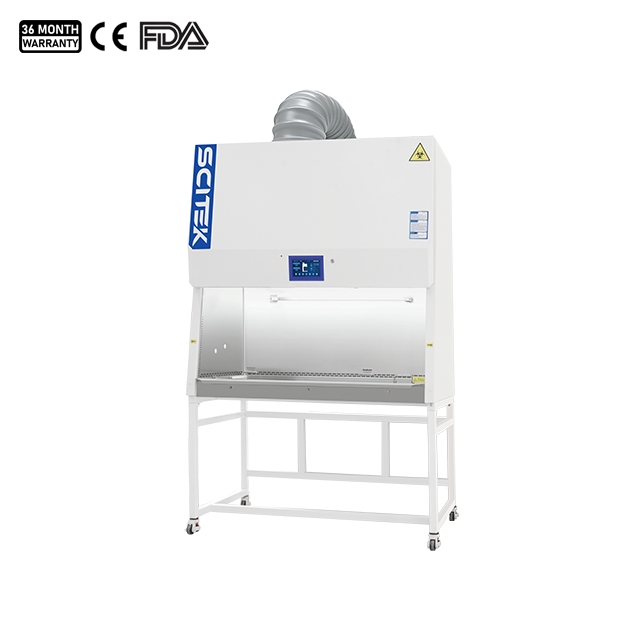
Filtered air discharged into the room (or via a canopy exhaust to outdoors)
Must be hard-ducted to the outdoors via dedicated exhaust system
Situations involving volatile toxic chemicals or radionuclides alongside biological agents
Critical Limitation
Must NOT be used with significant amounts of volatile hazardous chemicals!
Must NOT lose exhaust airflow. If the external blower stops, contamination can escape immediately.
One-Sentence Selection Guide
Choose Type A2 unless your work involves volatile toxic substances.
Choose Type B2 whenever volatile chemicals or radionuclides are present.
Partnering with SCITEK to Develop Future-Oriented Laboratories for the Post-Pandemic Era
Biosafety is not just theoretical, it is a rigorous science involving aerodynamics, fluid mechanics, and microbiology. As a professional guardian of laboratory safety, Scitek offers the following series of biosafety cabinets.
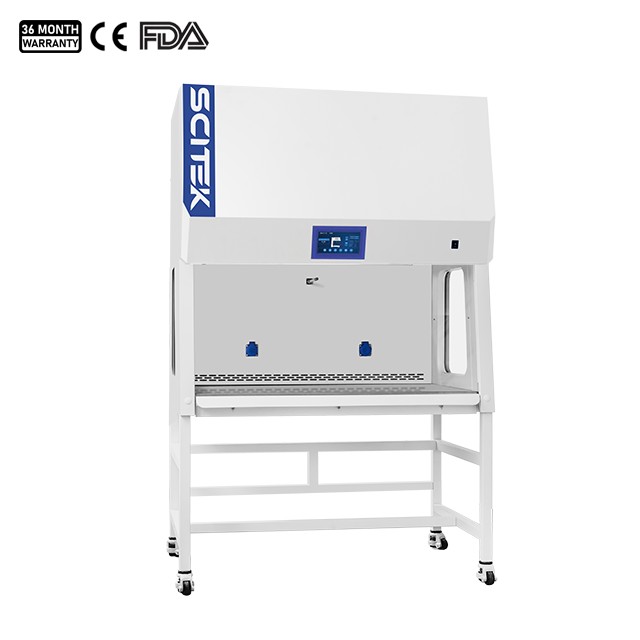
For Class II biosafety cabinet
Choose SCITEK, and you'll get the following “heavy-duty standard features” with every purchase:
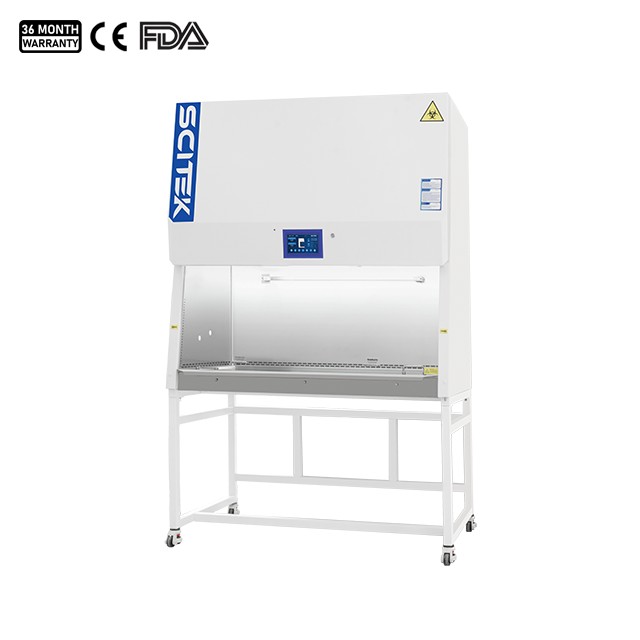
Unique perforations on all 4 sides, achieving full negative pressure airflow. Offering greater uniformity than a 2 sided perforated design, ensuring no trace of aerosol escapes.
Standard Configuration: Smart touch screen + Microcomputer real-time monitoring system +Foot switch. We committed to bringing you ultimate value with true sincerity.
Electro-galvanized steel sheet, electrostatic spraying process, with antibacterial powder coating, corrosion resistant, and safer.
Air velocity sensor monitor and display wind speed in real time and enable precise control.
Work area constructed entirely from 304 stainless steel with a removable design for user-friendly cleaning.
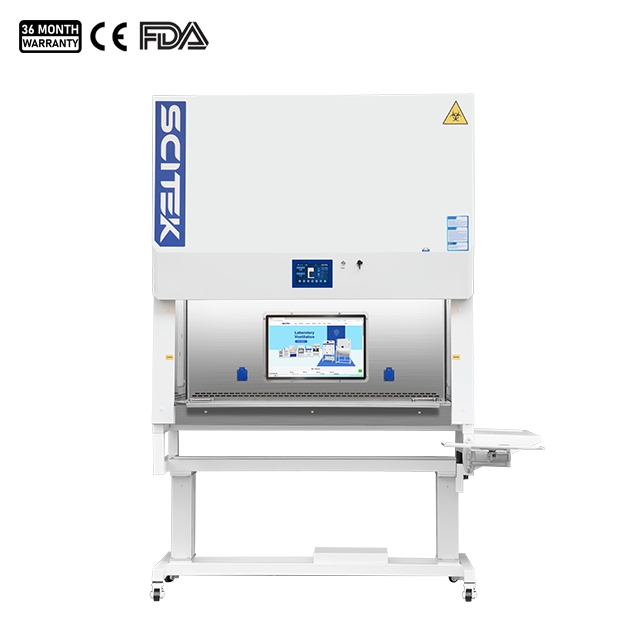
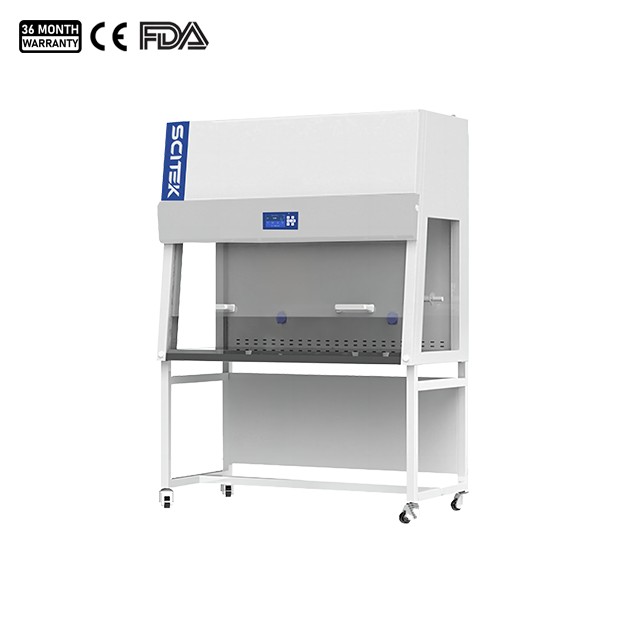
With the explosive growth of automated and smart labs, SCITEK has launched customized smart upgrade options for specific applications. BSC-IIA2-1500HE not only demonstrates our core strength in industrial design but also helps your lab seamlessly enter the digital age.
Built-in 21.5-inch extra-large touchscreen, researchers can access standard operating procedures (SOPs) and record experimental data directly within the cabinet while performing aseptic operations, without looking up or leaving the work area.
An integrated keyboard/mouse stand is specifically designed for controlling the built-in large screen. This significantly frees up workspace and enables more efficient, paperless, and safer operations.
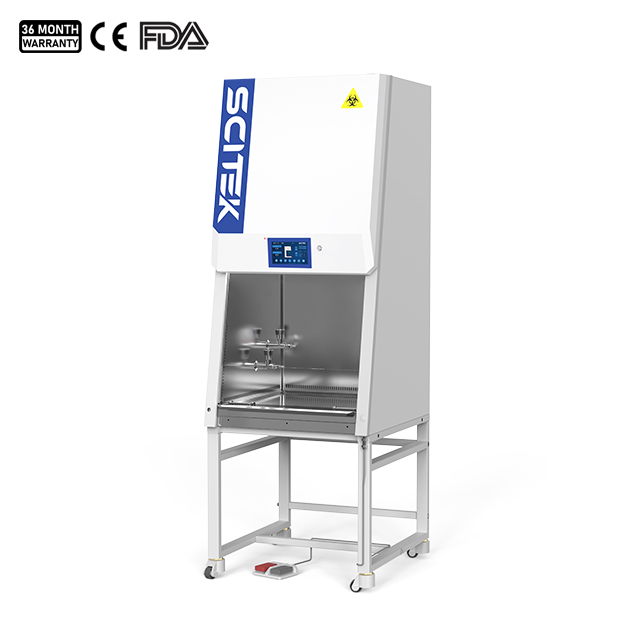
Our 2FT Class II biosafety cabinet breaks free from space constraints, making it the optimal choice for mobile healthcare and ultra-compact laboratories:
For Class I biosafety abinet
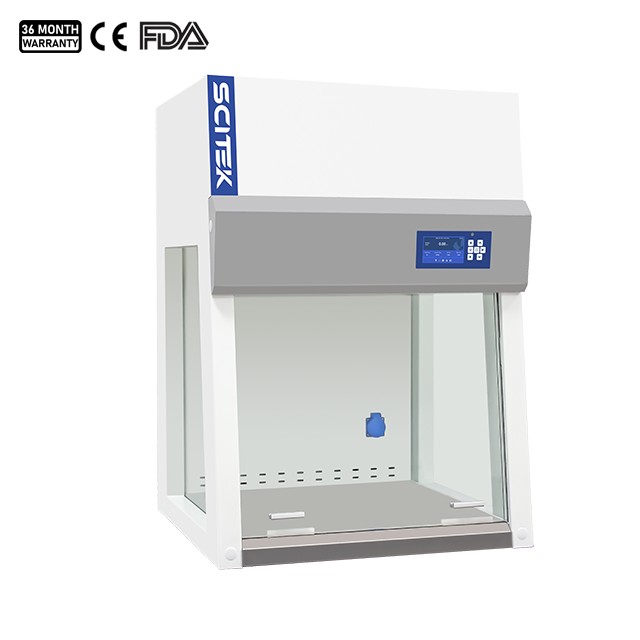
SCITEK also offer Class I biosafety cabinets that combines practicality and aesthetic design:
Comes standard with a spacious 7-inch touchscreen and provides real-time dynamic monitoring of all parameters, intuitively displaying real-time laminar flow velocity
Two side glass windows installed for easy experiment observation. With built-in waterproof socket provide convenience for small instruments to be used in the operating area
LCD display with intuitive and easy-to-use microprocessor controller, brushed stainless steel work surface is for easy cleaning.
Ergonomic Control Panel Location, centered and angled down for an easy reach & viewing.
2FT Class I biosafety cabinet can be placed directly on an existing lab bench without a base, or it can be placed independently with a Base Stand, flexibly adapting to various compact spaces.
What Does SCITEK Offer?
In the post-pandemic era, biosafety cabinets are no longer just standard laboratory equipment, they are the core cornerstone of global biosafety and a crucial line of defense for scientific progress. At SCITEK, we do more than just manufacture equipment – we craft reassurance, delivering uncompromising safety and unrivalled ergonomics. Our biosafety cabinets are designed to empower the next generation of life science exploration. SCITEK works alongside you to safeguard your laboratory and researchers, preparing you to face the future.
As a professional lab and medical equipment manufacturer, Scitek Global is certified by ISO 9001, ISO 13485, ISO 45001 and ISO 14001. Almost all our products are certified by ETL, CE and FDA .
Scitek Global looks forward to establishing cooperation with more distributors all over the world, and working together to create greater customer value.

 English