You are here:Home » Applications » Reasons Why Laboratories Rely on Water Purification Systems
Reasons Why Laboratories Rely on Water Purification Systems
Views: 1023 Author: Yammi Publish Time: 2026-01-23 Origin: Site
Pure water is an indispensable reagent for conducting experiments. Untreated tap water contains dissolved ions, organic compounds, microorganisms, and particulates. These substances can significantly compromise experimental accuracy, instrument performance, and data reproducibility. Therefore, water purification systems constitute essential laboratory infrastructure, and improving water quality and purification levels is critical to the success of laboratory experiments. This article will explore why every laboratory requires a reliable water purification system.
The Critical Role of Pure Water in Laboratory Research
Pure water is an indispensable resource in laboratory research, serving as an essential component in numerous experimental processes demanding the highest purity standards. However, not all water possesses the same level of purity. Pure water plays a vital role in maintaining the integrity and accuracy of scientific experiments.
Common Laboratory Water
Type
Resistivity
Application
Type I
≥18.2 MΩ·cm
Precision Analysis, Molecular Biology
Type II
≥10 MΩ·cm
Routine Analysis, Culture Media
Type III
≥0.05 MΩ·cm
Cleaning, Water Supply Pretreatment
I. Tap Water
Characteristics: Contains dissolved salts, organic matter, microorganisms, and particulate impurities.
Uses: Initial rinsing of glassware, cooling water, non-critical experiments
Applications: HPLC, ICP-MS, and molecular biology experiments
Standard: ASTM Type I / ISO Grade 1
VI. Sterile Water
Characteristics: Sterilized, free of viable microorganisms
Applications: Cell culture, clinical, and pharmaceutical applications
Note: Not equivalent to ultrapure water
The Critical Role of Pure Water in Laboratory Research
Water is an indispensable resource in laboratory research, serving as a crucial component in numerous experimental processes that demand the highest purity standards. However, not all water possesses the same level of purity. By removing ions and other contaminants, pure water plays a vital role in maintaining the integrity and accuracy of scientific experiments.
Sample Preparation: Pure water is extensively used for diluting samples, preparing reagents, and formulating solutions. It ensures solution purity and prevents adverse chemical reactions that could compromise experimental outcomes.
Cleaning and Disinfection: In laboratories, using pure water to clean equipment is crucial to prevent the accumulation of residual contaminants or minerals.
Chemical Reactions: Many chemical reactions and processes rely on pure water as a solvent. Impure water containing ions or organic compounds can interfere with reaction outcomes, leading to inaccurate data or even failed experiments.
Cell Culture: Pure water ensures no harmful contaminants interfere with cell growth during cell culture processes.
Water Purification Methods
Laboratory water purification systems employ multiple purification technologies, typically used in combination to achieve high-purity water:
Reverse Osmosis (RO): Utilizes pressure to force water through a semi-permeable membrane, effectively removing dissolved salts, bacteria, and organic molecules.
Deionization (DI): Uses ion exchange resins to replace unwanted ions with hydrogen and hydroxide ions.
Ultrafiltration: Removes high-molecular-weight contaminants, including viruses and endotoxins, by passing water through specialized membranes.
Activated Carbon: Organic compounds bind to or adhere to the surface of activated carbon filters through adsorption.
Ultraviolet Purification: Utilizes ultraviolet radiation to kill bacteria and break down organic molecules.
Recommended Machines for Lab Water Purification Systems
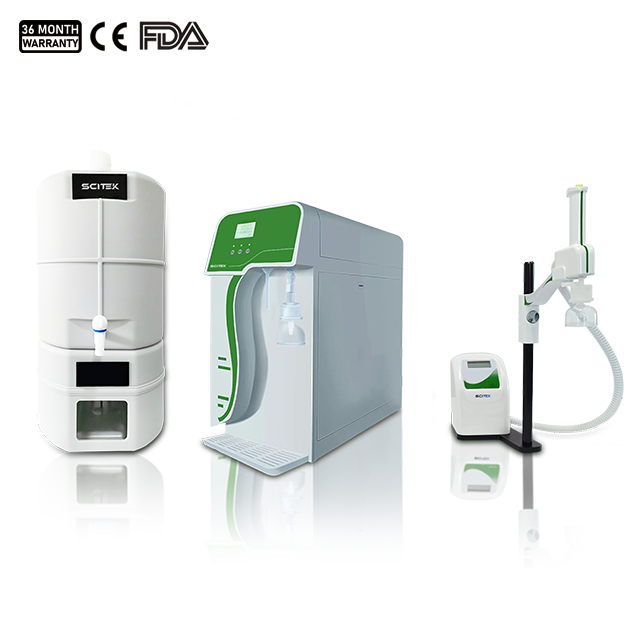
Water purity is a fundamental requirement in laboratories, directly impacting experimental accuracy. These water purification systems are designed to remove various contaminants, including ions, TOC, bacteria, particulates, and more.
High-End Ultrapure Water Purification Systems(Type I)
Laboratory Ultrapure Water System (15 L/h UV): Suitable for experiments demanding the highest water quality, such as analytical chemistry, cell culture, and PCR; features a UV sterilization module for enhanced TOC control.
Mid-Range Universal Lab Water Purification Systems
Comprehensive lab water purification solution: Incorporating pre-treatment + RO + DI units, delivering stable, low-maintenance pure water for the vast majority of laboratories.
Untreated tap water contains various impurities, such as dissolved ions, organic matter, microorganisms, and suspended particles. These contaminants can interfere with experimental reactions, affect test results, reduce instrument operational stability, and even cause equipment damage, thereby compromising data accuracy and reproducibility.
Therefore, laboratories must be equipped with water purification systems to continuously and reliably supply high-quality water meeting relevant purity standards, fulfilling the fundamental requirements for experiments, analyses, and instrument operation.
As a professional lab and medical equipment manufacturer, Scitek Global is certified by ISO 9001, ISO 13485, ISO 45001 and ISO 14001. Almost all our products are certified by ETL, CE and FDA .
Scitek Global looks forward to establishing cooperation with more distributors all over the world, and working together to create greater customer value.

 English