You are here:Home » Applications » Refrigerator that Complies with Medical & Laboratory Standards
Refrigerator that Complies with Medical & Laboratory Standards
Views: 1022 Author: Yammi Publish Time: 2026-01-22 Origin: Site
The preservation of sensitive laboratory samples and materials, along with cold chain management in biological research and the pharmaceutical industry, constitutes an indispensable core component of these fields. Vaccines, biological samples, enzyme preparations, antibodies, sera, and blood bags are highly sensitive to storage temperatures. Deviations in temperature not only directly impact experimental reproducibility and data reliability but may also lead to reduced efficacy or even complete failure of pharmaceutical products. To meet stringent requirements for medical compliance, research accuracy, and pharmaceutical quality management, we must select refrigerators that meet the standards of medical and laboratory environments.
Factors to Consider When Purchasing Laboratory/Medical Refrigerators
For temperature-sensitive samples such as vaccines, prolonged storage in environments with frequent defrost cycles or temperature fluctuations can significantly compromise sample stability or even render them ineffective. Therefore, selecting a professional laboratory refrigerator with stable temperature control capabilities is crucial based on the specific temperature requirements of stored items.
Although laboratory refrigerators carry a higher procurement cost than household or standard commercial models, the potential economic losses and compliance risks stemming from sample damage, failed experiments, or medical hazards due to inadequate temperature control often far exceed the initial equipment investment. This guide emphasizes the necessity and key value of deploying professional laboratory refrigerators within laboratory environments.
Laboratory refrigerators can slow bacterial growth in samples
Bacteria proliferate rapidly within the temperature range of 20–60°C. Storing samples in a laboratory refrigerator set to the desired temperature can significantly inhibit or slow bacterial growth. Laboratory refrigerators maintained at 2–8 °C significantly reduce bacterial metabolic rates, inhibit cell division, and delay sample spoilage or deterioration.
Yes, but they typically do not completely eliminate bacteria. Ultra-low temperature freezers at -86°C significantly reduce chemical reactions within cultures, enabling cultures/samples to be stored for up to 15 years without significant loss of activity.
Safety Alarm System
Laboratory refrigerators integrate multi-level safety monitoring mechanisms to provide real-time surveillance of conditions such as high temperature, low temperature, power failure, sensor malfunctions, and abnormal door openings. Combining audible and visual alarms with external remote alarm interfaces, they deliver continuous risk alerts for critical samples. By swiftly detecting potential issues, these refrigerators help minimize sample loss and material waste caused by improper storage conditions. Additionally, select models feature electronic locks and keypads to prevent unauthorized access to samples and pharmaceuticals.
Recommended Laboratory Refrigerators
2-8°C Laboratory Refrigerators
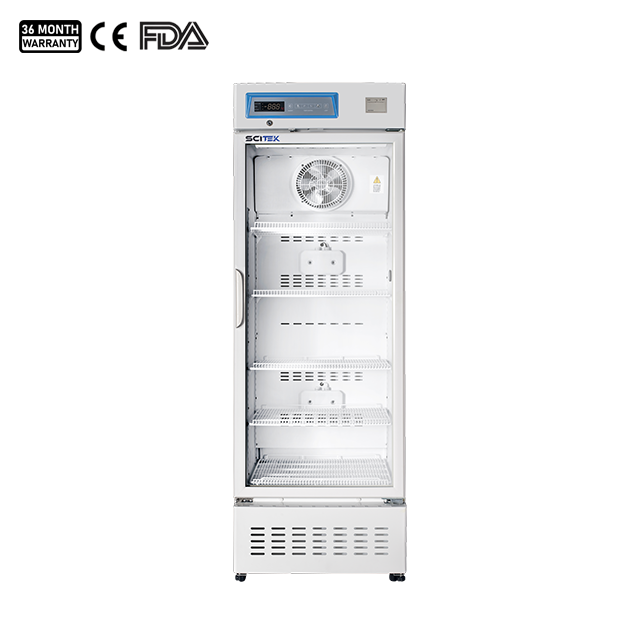
Scitek refrigerators utilize a microprocessor control system, combining high-precision digital temperature sensors with adaptive control algorithms to achieve high-resolution temperature regulation within the chamber. Under typical operating conditions, temperature control accuracy reaches ±0.5°C to ±1°C, effectively suppressing short-cycle fluctuations and long-term drift.
The inner chamber utilizes corrosion-resistant, easy-to-clean medical-grade materials compatible with standard sterilization protocols. The overall structure is reliability-engineered for long-term continuous operation and high-frequency use, ensuring stable performance in demanding environments.
The low-temperature freezer employs forced air cooling circulation, multi-air duct distribution, and an optimized evaporator layout. Scitek achieves high temperature uniformity across all storage zones within the chamber, significantly reducing sample risks caused by local temperature variations. It meets laboratory requirements for repeatability and consistency.
Scitek ultra cold freezers utilize a microprocessor control system, integrating high-precision digital temperature sensors with adaptive control algorithms to achieve high-resolution regulation of internal chamber temperatures. Temperature control accuracy ranges from ±0.5°C to ±1°C, effectively suppressing short-cycle fluctuations and long-term drift.
Additionally, technical documentation and supporting materials can be provided, such as Declarations of Conformity, factory test records, calibration recommendations, and user manuals. These resources establish the technical foundation for users to implement comprehensive equipment validation and maintenance systems.
Standard System and Regulatory Compliance
Scitek adheres to the core design principles of “stability, controllability, and compliance.” We build specialized refrigeration solutions tailored for medical and laboratory applications at the system architecture level, rather than simply modifying commercial refrigeration equipment. Scitek medical and laboratory-grade refrigerators are engineered and manufactured to meet multiple international standards and regulatory requirements, including but not limited to:
ISO 13485: Medical Device Quality Management System
ISO 9001: Quality Management System
IEC 61010: Safety Standards for Laboratory and Medical Electrical Equipment
CE: EU Safety, Health, and Environmental Directives
FDA 21 CFR Part 11 / Part 210 & 211 (where applicable)
WHO Technical Guidelines for Cold Chain and Laboratory Equipment (applicable models)
By embedding compliance requirements into the product design input phase, Scitek ensures verifiable regulatory consistency throughout the equipment's lifecycle, providing reliable support for users undergoing GMP, GLP, GSP, and related audits.
Maintenance of Laboratory/Medical Refrigerators
Minimize unnecessary door openings to reduce temperature fluctuations.
Maintain a cool, moderately humid environment to ensure stable operation.
Position the refrigerator in a room with moderate temperature, good ventilation, and minimal foot traffic.
Leave 4–5 inches of clearance around ventilation openings to ensure airflow.
Promptly remove excess samples and expired reagents to maintain cleanliness of the unit and surrounding area.
Clean condenser coils and compressor areas at least twice yearly; increase frequency in high-dust environments.
Remove dust from air intakes and coils; replace worn seals when necessary.
Perform manual defrosting as needed to prevent performance degradation or malfunctions.
Disconnect power to unused refrigeration equipment promptly to reduce energy consumption.
As a professional lab and medical equipment manufacturer, Scitek Global is certified by ISO 9001, ISO 13485, ISO 45001 and ISO 14001. Almost all our products are certified by ETL, CE and FDA .
Scitek Global looks forward to establishing cooperation with more distributors all over the world, and working together to create greater customer value.

 English