You are here:Home » Applications » Why Closed Cup Flash Point Testing Matters for Accurate Flammability Analysis
Why Closed Cup Flash Point Testing Matters for Accurate Flammability Analysis
Views: 626 Author: Yammi Publish Time: 2026-06-26 Origin: Site
Flash point is one of the most critical parameters for evaluating the flammability and safe handling of petroleum products, chemicals, solvents, paints, and other combustible liquids. Accurate flash point determination is essential for product classification, quality control, transportation, storage, and regulatory compliance. Among the available testing methods, the Closed Cup Flash Point Tester is widely recognized for providing precise and reliable results, particularly for volatile liquids with lower flash points. But how does a closed cup flash point tester work, what industries rely on it, and how can you choose the right model for your laboratory? This guide explores its working principle, key applications, major testing standards, and essential selection factors to help you make an informed decision.
How Does a Closed-Cup Flash Point Tester Work?
The entire closed-cup flash point testing process is roughly as follows:
Step 1: Sample Loading—Pour a specified volume of liquid sample (typically 50–100 milliliters) into a precision-sealed metal cup.
Step 2: Heating—Heat the sample uniformly at a strictly controlled rate (typically 1–3 °C per minute).
Step 3: Stirring—The sample is continuously stirred throughout the test to ensure uniform temperature distribution throughout the cup.
Step 4: Ignition Testing—At specific temperature intervals, an ignition source is introduced through a small hole in the cup lid to observe whether a flash of flame occurs.
Step 5: Determining the Flash Point—When the concentration of the sample’s vapors reaches the flammable range, a brief, instantaneous flame appears upon contact with the ignition source. The temperature recorded at this moment is the closed-cup flash point of the liquid.
Step 6: Cooling—After the test is complete, the closed-cup flash point tester automatically cools down, preparing for the next test.
Throughout the entire process, the “closed-cup” design is crucial—since vapors cannot escape, the test results are more accurate than those obtained using the open-cup method and more closely reflect the actual conditions under which the liquid is stored in a sealed container.
Why is the flash point test so important?
The flash point is more than just a number; it is a core safety and quality indicator that spans a liquid’s entire life cycle.
The flash point determines a liquid’s fire hazard classification. According to internationally accepted classification standards, liquids with a flash point below 60°C are classified as flammable; those below 23°C are highly flammable; and those below 0°C are extremely flammable. This classification directly affects how liquids are stored, transportation and packaging requirements, fire protection system configurations, and emergency response measures.
Main Components of a Closed-Cup Flash Point Tester
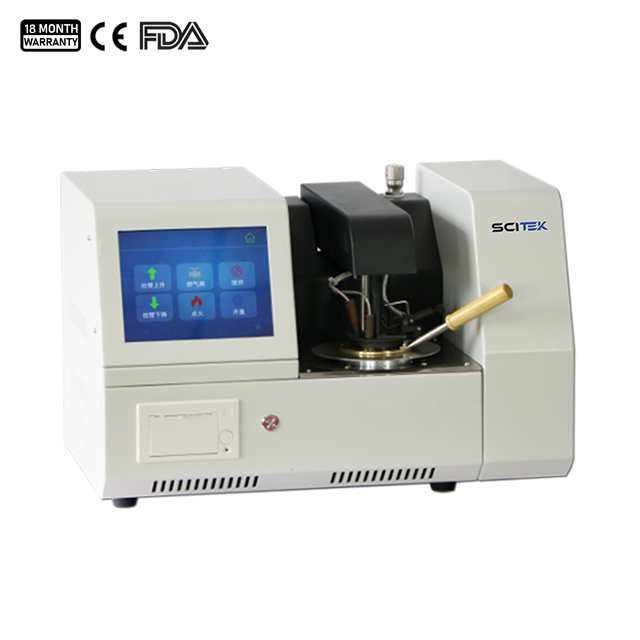
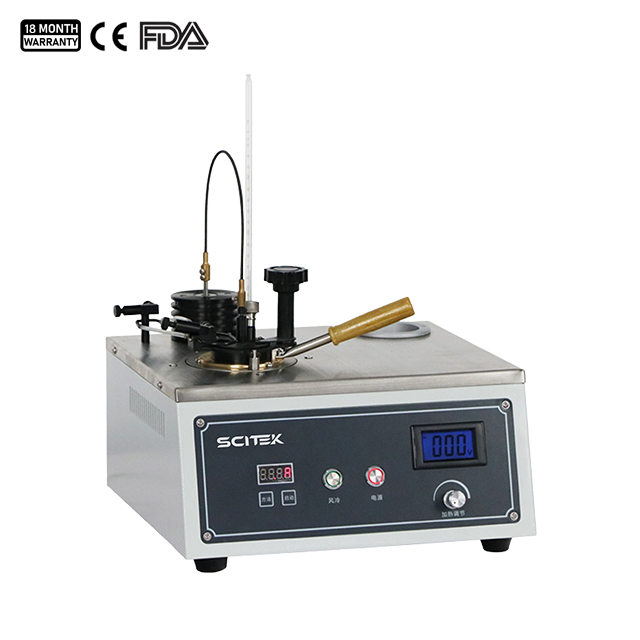
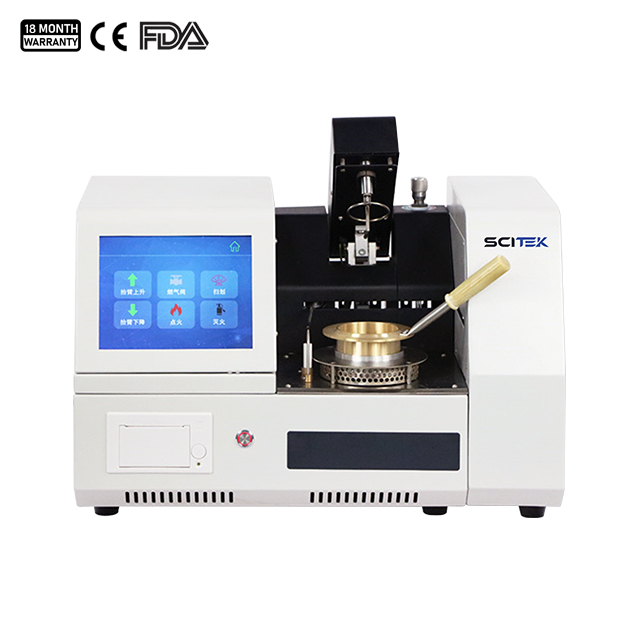
A typical closed-cup flash point tester consists of the following core components:
Test cup (sample cup)—Typically precision-machined from brass or stainless steel, it is used to hold the liquid sample.
Cup lid assembly—The sealed cup lid has multiple openings for installing the stirrer, temperature sensor, and ignition device.
Heating System — Utilizes electric heating elements combined with a PID temperature control algorithm to precisely regulate the heating rate, ensuring the test process complies with standard requirements.
Stirring Mechanism — A motor-driven stirrer rotates continuously to ensure uniform temperature distribution throughout the sample and prevent localized overheating.
Temperature Sensor — A high-precision platinum resistance thermometer (PT100) with an accuracy of ±0.1°C, which is critical for ensuring test accuracy.
Ignition System—This can be a gas flame (propane or butane), an electric spark, or an electric heating wire.
Flash-Fire Detection System—A thermal sensor or ion detection ring automatically detects the instant a flash fire occurs, eliminating the need for manual observation.
Control Unit—A microprocessor or computer system responsible for controlling heating, stirring, ignition sequencing, and data logging.
Cooling System—A built-in fan or semiconductor cooler that rapidly cools the sample after testing is complete, shortening the time between tests.
Data Output Interface—Supports printer output, USB export, or integration with LIMS systems.
How to Use an Automatic Closed-Cup Flash Point Tester
The operating procedure for the closed-cup flash point tester is as follows:
First, prepare the sample, ensuring it contains no moisture or visible impurities. Then, pour the sample into a clean, dry test cup, filling it to the specified mark. Place the test cup into the instrument and secure it in place.
Next, set the test parameters on the touchscreen: enter the estimated flash point range, confirm that all other parameters are correct, and press the “Start” button.
The closed-cup flash point tester will automatically perform all subsequent operations: heating at the rate specified by the standard, continuous stirring, introducing an ignition source at the correct temperature intervals, detecting flash ignition, recording the flash point temperature, and automatically applying atmospheric pressure correction. Once the test is complete, the instrument will automatically cool down and be ready for the next test.
Throughout the entire process, operator intervention is minimal. This is why fully automatic closed-cup flash point testers are becoming increasingly popular—they significantly reduce human error and improve testing efficiency and repeatability.
Note:
Tests should be conducted in a well-ventilated area.
Operators should wear protective gloves and safety goggles.
The test cup must be thoroughly cleaned after each use to prevent cross-contamination.
Calibration should be performed regularly using standard reference materials.
Main Types of Closed-Cup Flash Point Testers
Pensky-Martens Closed-Cup Method — This is the most widely used method, with a temperature range from room temperature to approximately 400°C. It is suitable for the vast majority of samples, including petroleum products, fuel oils, and lubricants.
Tag Closed-Cup Method — The temperature range is between -20°C and 100°C. It is specifically designed for highly volatile liquids, such as solvents, paint thinners, and other low-flash-point substances.
Abel Closed Cup Method — Suitable for low-viscosity liquids and aviation fuels. It is more commonly used in the European market.
Small-Scale/Rapid Closed Cup Method — Requires only 1–2 mL of sample and offers fast testing speeds, making it suitable for high-throughput laboratories or the testing of valuable samples.
Difference between the closed-cup method and the open-cup method?
This is the most frequently asked question regarding flash point testing. The key difference between the two lies in the testing environment.
The closed-cup method is conducted in a sealed container, preventing vapors from escaping. As a result, the measured flash point is lower and more closely reflects the actual conditions of the liquid in enclosed containers such as storage tanks and drums. The closed-cup method offers better repeatability and higher accuracy, which is why it is adopted by the vast majority of safety regulations.
The open-cup method is conducted in an open container, allowing vapors to diffuse freely into the air. Consequently, a higher temperature is required to reach a flammable concentration, resulting in a higher flash point value. The open-cup method more closely simulates a scenario where a liquid leaks into an open environment.
So, how should you choose?
A simple rule of thumb: if the liquid is stored or transported in a sealed container, choose the closed-cup method. The open-cup method is primarily used for high-viscosity substances, such as heavy lubricating oils and asphalt, which are difficult to heat uniformly in a closed-cup apparatus.
How to Choose the Right Closed-Cup Flash Point Tester
When selecting a closed-cup flash point tester, it is recommended to consider the following factors comprehensively:
Identify the testing standards that must be followed. Choosing an instrument that supports multiple standards will provide greater flexibility.
Consider the type of sample. Light fuels such as gasoline and diesel require the Pensky-Martin or TEG closed-cup methods; transformer oil and lubricating oil require the Pensky-Martens method with a wide temperature range; new materials such as lithium-ion battery electrolytes require high-precision, compact, and rapid testing methods.
Assess the testing volume. For fewer than 10 tests per day, a manual or semi-automatic model will suffice; for 10–50 tests per day, a semi-automatic or fully automatic model is recommended; for more than 50 tests per day, a fully automatic or even a multi-cup model is a more efficient choice.
Pay attention to key technical parameters. The temperature range must cover your sample requirements; temperature accuracy should be at least ±0.1°C; repeatability should be ≤1°C; and data management functions should support USB export, printing, and LIMS integration.
Consider the total cost of ownership. Although fully automatic instruments have a higher initial price, they save significant labor costs and are often more economical in the long run. Additionally, consider the costs of consumables, calibration and maintenance, and the availability of after-sales service.
Recommended Scitek Flash Point Testers
Scitek Global is a professional manufacturer of laboratory analytical instruments that has obtained international certifications such as ISO 9001, ISO 13485, CE, and FDA. With extensive R&D and manufacturing experience in the field of precision instruments, Scitek’s product line includes biochemical analyzers, flame photometers, UV spectrophotometers, and more. Its flash point testing solutions are also designed with a focus on high precision and reliability.
The key advantages of Scitek’s closed-cup flash point testers include strict compliance with international standards such as ASTM D93, ISO 2719, and GB/T 261, making them suitable for export to global markets.
For more information on specific models, technical specifications, and pricing for Scitek closed-cup flash point testers, please visit the Scitek website or contact our sales team for a customized solution.
As a professional lab and medical equipment manufacturer, Scitek Global is certified by ISO 9001, ISO 13485, ISO 45001 and ISO 14001. Almost all our products are certified by ETL, CE and FDA .
Scitek Global looks forward to establishing cooperation with more distributors all over the world, and working together to create greater customer value.

 English