You are here:Home » Applications » PCR Thermal Cycler: Redefining Efficiency in Molecular Diagnostics
PCR Thermal Cycler: Redefining Efficiency in Molecular Diagnostics
Views: 604 Author: Yammi Publish Time: 2026-06-04 Origin: Site
PCR thermal cyclers are indispensable core instruments in biomolecular research and clinical diagnostics. As precision medicine, infectious disease prevention and control, and genomics research continue to advance, the market is placing higher demands on the performance, intelligence, and user experience of PCR equipment. SCITEK’s newly launched next-generation intelligent gradient PCR thermal cycler is a powerful response to this trend.
Market Outlook for Thermal Cyclers
The global thermal cycler market is projected to reach approximately $1.02 billion to $1.15 billion in 2024. It is expected to grow to $1.82 billion to $2.29 billion by 2033, with a compound annual growth rate (CAGR) of 5% to 8%. Among these regions, the Asia-Pacific region is the fastest-growing market, driven primarily by:
Demand for infectious disease prevention and control: PCR-based testing is widely used for the screening and monitoring of infectious diseases such as tuberculosis, HIV/AIDS, and emerging viruses;
Clinical diagnostic needs: In the post-pandemic era, healthcare systems worldwide are continuing to increase their long-term investment in molecular testing capabilities;
Biopharmaceutical R&D: Growing investment in genomics, gene editing, and personalized medicine continues to drive demand for equipment;
Expansion into emerging markets: Developing countries in Asia, Africa, and Latin America have a particularly urgent need for cost-effective molecular diagnostic equipment.
The “Hidden Costs” of Traditional PCR Instruments
Despite the promising market outlook, users still face numerous challenges when using traditional PCR instruments:
1. Questionable Reliability of Results
Poor temperature uniformity: Temperature variations within the module lead to inconsistent amplification efficiency across different wells, affecting experimental reproducibility and accuracy;
Insufficient temperature control precision: Even minor temperature deviations can trigger nonspecific amplification, potentially causing experimental failure.
2. Low Experimental Efficiency
Time-consuming temperature optimization: Traditional instruments require multiple repetitions to determine the optimal annealing temperature, making the process cumbersome;
Slow heating and cooling rates: Lengthy temperature control cycles consume significant time, reducing equipment throughput.
3. Inconvenient Operation and Data Management
Outdated interface: Small screens, button-based operation, and complex program logic result in a steep learning curve;
Limited data storage: Data is stored only locally, making remote monitoring and data sharing across multiple devices difficult;
Cumbersome operation: Heat block pressure must be adjusted manually, and operating the device at high temperatures poses safety risks.
A Brand-New Solution: SCITEK’s Next-Generation Smart PCR Thermal Cycler
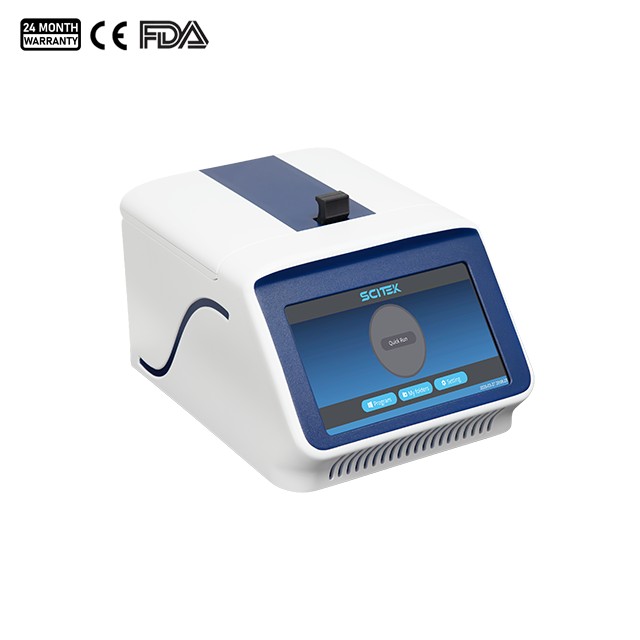
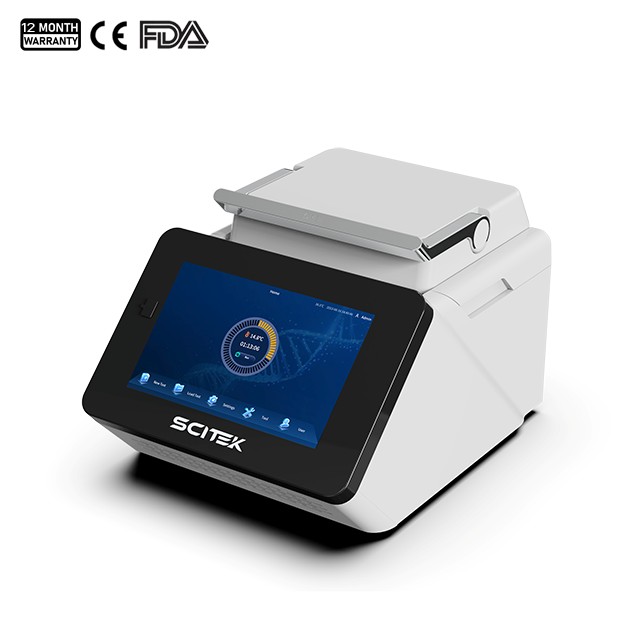
To address these challenges, SCITEK has launched the PCR-TC96M / PCR-TC96SM series of smart gradient PCR thermal cyclers. Leveraging proprietary core technologies, these instruments deliver a highly efficient, precise, and intelligent laboratory experience for users.
Core Advantage 1: Multi-Variable Coupled Optimization for Precise Temperature Control
The PCR Thermal Cycler employs an advanced multi-variable coupled optimization algorithm. By continuously monitoring and adjusting multiple temperature variables, combined with three sets of independent heating/cooling modules that optimize heat exchange pathways, it achieves:
Maximum heating rate: 5°C/s
Temperature Fluctuation: ≤ ±0.1°C
Customer Value: Eliminates experimental failures caused by temperature fluctuations at the source, significantly shortens experimental cycles, and improves equipment utilization.
Core Advantage 2: Intelligent Gradient Function—Identify Optimal Conditions in a Single Experiment
Wide Gradient Range: 30°C–99°C, with a gradient span of 1°C–42°C
Gradient Temperature Uniformity: Up to ±0.3°C
12-Channel Independent Temperature Control: Enables simultaneous screening of 12 annealing temperatures ranging from 45°C to 65°C in a single experiment. Supports concurrent operation of up to 12 different primer pairs.
Customer Value: Significantly reduces time, reagent, and labor costs while accelerating the experimental optimization process.
Core Advantage 3: Intelligent User Experience
Feature
Technical Highlights
Customer Benefits
10.1-inch HD Touchscreen
Industrial-grade touchscreen with an intuitive graphical user interface (GUI)
Tablet-like operation for enhanced user experience, reduced training requirements, and minimized operational errors
Automatic Heated Lid Pressure Control
Automatically applies optimal pressure with intelligent temperature adjustment from 30°C to 110°C
Eliminates manual adjustment, preventing sample evaporation and protecting the thermal block from damage
4°C Sample Preservation Function
Automatically maintains samples at 4°C for up to 24 hours after program completion
Prevents sample degradation and provides flexibility for extended experimental workflows
Large-Capacity Data Storage
Built-in high-capacity memory stores up to 10,000 programs and experimental records
Enables quick access to historical data, facilitates result comparison, and supports method development and optimization
How to Choose a PCR Thermal Cycler
Based on your laboratory’s specific needs, you can select the appropriate PCR thermal cycler configuration by considering the following factors:
Consumable compatibility: What specifications of PCR tubes or plates does your laboratory require?
Gradient requirements: Do you need gradient amplification capabilities for condition optimization?
Throughput requirements: 96-well or 384-well?
Clarifying these points is crucial for selecting a PCR thermal cycler that suits your laboratory. Finally, consider after-sales service. Since PCR instruments are precision laboratory equipment, reliable maintenance support and spare parts supply can minimize the impact of equipment failures on experimental progress.
Conclusion
From traditional PCR to intelligent gradient PCR, every step in equipment evolution is driving molecular diagnostics toward greater precision, efficiency, and intelligence. SCITEK’s next-generation intelligent gradient PCR thermal cycler is not only a high-performance temperature-controlled device but also a key component in the digital and intelligent upgrade of laboratories.
As a professional lab and medical equipment manufacturer, Scitek Global is certified by ISO 9001, ISO 13485, ISO 45001 and ISO 14001. Almost all our products are certified by ETL, CE and FDA .
Scitek Global looks forward to establishing cooperation with more distributors all over the world, and working together to create greater customer value.

 English