You are here:Home » Applications » One Mistake Can Ruin Your Plasma Sample: Preparation, Storage & Thawing Tips
One Mistake Can Ruin Your Plasma Sample: Preparation, Storage & Thawing Tips
Views: 623 Author: Yammi Publish Time: 2026-06-23 Origin: Site
Plasma has a wide range of applications and is indispensable in blood transfusions and clinical treatment. To ensure safe use, plasma and other blood components must undergo rigorous testing and be properly stored in blood banks. Therefore, medical institutions across the country are equipped with sophisticated blood storage and thawing equipment—such as specialized freezers, refrigerators, and plasma thawers. This equipment is used to precisely maintain refrigeration temperatures, effectively protect blood components, prevent their degradation, and prepare them for subsequent transport and use. The following section will provide a detailed overview of the proper procedures for the preparation, storage, and thawing of plasma.
What Is Plasma?
Basic Definition
Plasma is the liquid component of blood and is pale yellow in color. It is the liquid fraction obtained by centrifuging whole blood after anticoagulation to remove blood cells. Plasma accounts for approximately 55%–60% of the volume of whole blood and is an important component of the body’s internal environment.
Major Components of Plasma
Approximately 90% of plasma is water; the remainder consists of various solid components dissolved in water:
Plasma proteins: including albumin, globulins, and fibrinogen
Albumin: Maintains plasma colloid osmotic pressure, prevents fluid from leaking out of blood vessels, and maintains stable blood volume
Globulins: Participate in the body’s immune defense; the antibodies (immunoglobulins) within them can specifically recognize and neutralize pathogens
Fibrinogen: A key protein in the blood clotting process; under the action of thrombin, it is converted into insoluble fibrin, forming a blood clot to stop bleeding
Electrolytes: Sodium ions, potassium ions, calcium ions, chloride ions, etc., which maintain osmotic pressure balance, neuromuscular excitability, and acid-base balance
Nutrients: Glucose, amino acids, lipids, vitamins, etc.
Hormones: Act as signaling molecules to regulate various physiological processes
Metabolic waste products: Urea, creatinine, uric acid, etc., transported via plasma to excretory organs
Functions of Plasma
Transport: Delivers oxygen, nutrients, and hormones to tissues throughout the body, while transporting carbon dioxide and metabolic waste products to the lungs and kidneys for excretion
Maintenance of Internal Environment Stability: Maintains blood acid-base balance through buffering systems (bicarbonate, phosphate, and proteins); the colloidal osmotic pressure formed by albumin maintains fluid balance between the intravascular and extravascular spaces
Immune Defense: Immunoglobulins (antibodies) recognize and neutralize pathogens, forming a nonspecific defense barrier
Blood Clotting and Hemostasis: Under the action of thrombin, fibrinogen is converted into fibrin polymers, which trap blood cells to form a blood clot. Concurrently, anticoagulant and fibrinolytic systems prevent excessive thrombus formation and degrade fibrin clots once hemostasis is complete
The Difference Between Plasma and Serum
Plasma and serum are two concepts that are often confused:
Plasma is the supernatant obtained by centrifuging whole blood after anticoagulation; it contains all coagulation factors, including fibrinogen.
Serum is the liquid that separates after blood has clotted naturally; it does not contain fibrinogen or certain coagulation factors.
In clinical blood transfusions, plasma products (such as fresh frozen plasma) are used. In some biochemical tests, serum and plasma can be used interchangeably; however, plasma must be used for coagulation function tests.
Clinical Significance of Plasma
Plasma itself and its separated components are important blood products with widespread applications in clinical medicine:
Fresh Frozen Plasma (FFP): Used to replenish clotting factors and treat coagulation disorders, massive bleeding, liver disease, etc.
Cryoprecipitate: Rich in Factor VIII, vWF, and fibrinogen; used to treat hemophilia A and fibrinogen deficiency
Human Albumin: Used to treat hypoproteinemia, burns, and ascites associated with cirrhosis
Immunoglobulins: Used to treat immunodeficiency disorders and autoimmune diseases
Plasma exchange: Used to remove pathogenic substances (such as autoantibodies and toxins) from the bloodstream
Understanding the basic definition, components, and functions of plasma is a prerequisite and foundation for comprehending subsequent plasma cryopreservation techniques.
Fresh Frozen Plasma (FFP) Preparation Process
Fresh Frozen Plasma (FFP) is a blood product prepared by separating whole blood within a specified time frame after collection and rapidly freezing it. It contains all coagulation factors, including the labile factors V and VIII.
Standard Preparation Process
Step 1: Whole Blood Collection
Collect whole blood using blood bags containing anticoagulants (CPD, CPDA-1) and immediately place them in a refrigerated environment at 4°C ± 2°C.
Step 2: Centrifugation (to be completed within 6–8 hours after blood collection)
Subject the whole blood to an initial high-speed centrifugation (5000 × g, 7 minutes) at 4°C ± 2°C. Use a plasma separator to separate the supernatant plasma into a transfer bag, then heat-seal the connecting tube. Depending on the preservative used, this step must be completed within 6 hours for ACD preservative and within 8 hours for CPD or CPDA-1 preservatives.
Step 3: Rapid Freezing
Place the separated plasma bags flat in a plasma rapid freezer and rapidly freeze them to a solid state at -30°C or below. The freezing time should be kept within 60 minutes to ensure the shortest possible time spent in the maximum ice crystal formation zone. Rapid freezing is a critical step in preserving the activity of coagulation factors.
Step 4: Long-Term Storage
Transfer the flash-frozen plasma to a plasma freezer set to -20°C or below. The shelf life is 1 year from the date of collection. Upon expiration of this period, the plasma automatically becomes standard frozen plasma (FP), with the shelf life extended to 4 years.
Types of Plasma
Plasma Product Type
Source
Key Components
Storage Condition
Shelf Life
Fresh Frozen Plasma (FFP)
Separated and rapidly frozen within 6–8 hours after blood collection
Contains all coagulation factors
≤ -20°C
1 year
Frozen Plasma (FP)
Prepared more than 6–8 hours after collection or converted from expired FFP
Reduced levels of Factors V and VIII
≤ -18°C
4 years
Cryoprecipitate
Precipitate obtained after thawing FFP at 4°C
Rich in Factor VIII, von Willebrand Factor (vWF), and fibrinogen
Cryoprecipitate Coagulation Factors: ≤ -18°C, Shelf life: 1 year
Categorized and Zoned Storage: Qualified products, products awaiting testing, and non-conforming products must be stored in separate zones and clearly labeled. Non-conforming plasma must be physically isolated to prevent accidental release from the warehouse.
Avoid Repeated Freezing and Thawing: Once thawed, plasma must not be refrozen under any circumstances. Repeated freezing and thawing leads to a progressive decline in coagulation factor activity, protein denaturation, and an increased risk of microbial contamination.
Temperature Monitoring: Automatic temperature loggers must be installed in storage and quick-freezing cold storage facilities. Temperature anomaly alarm devices must be provided. Measurement points must be installed at a height no lower than two-thirds of the plasma stack height.
Packaging Integrity: Plasma bags must be free of damage and leaks, and label information must be complete and traceable.
The Effect of Storage Temperature on Plasma Samples
Research in cryobiology has shown that under low-temperature conditions, the rates of biochemical reactions in living cells decrease significantly. At temperatures below -20°C, the activity of most enzymes is inhibited, and microbial growth essentially ceases. However, since water is the primary component of plasma (accounting for approximately 95%), improper freezing methods can easily lead to the formation of ice crystals, which damage protein structures and result in the inactivation of clotting factors.
Storage Characteristics at Different Temperature Ranges:
2–8°C Refrigeration: Slightly above freezing point; no damage from water freezing, but not suitable for long-term storage
-20°C Freezing: Below freezing point; this is the range where water crystallizes; samples must pass through this temperature range rapidly to minimize ice crystal damage
-80°C Ultra-low Temperature: Biochemical reactions are extremely slow; suitable for medium- to long-term storage
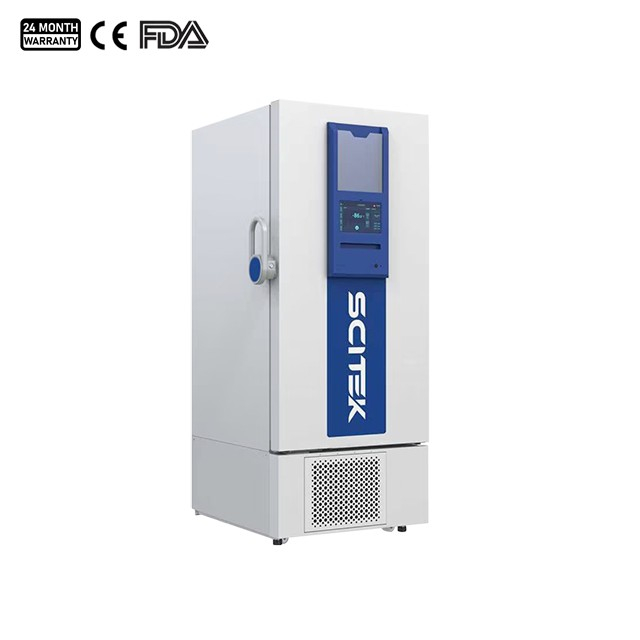
Quickly freezes plasma to help preserve coagulation factor activity and maintain plasma quality.
Provides stable temperatures down to -86°C for both freezing and long-term plasma preservation.
Ensures uniform cooling and consistent storage conditions throughout the chamber.
VIP insulation minimizes temperature fluctuations and improves energy efficiency.
Suitable for blood centers, transfusion departments, biobanks, and research laboratories.
Equipped with multiple alarms and protection systems to safeguard valuable plasma samples.
How to Thaw Plasma Bags and Samples?
Plasma thawing is a critical step in clinical transfusion and laboratory analysis; improper handling can directly lead to the inactivation of clotting factors.
Procedure:
Preparation: Preheat the constant-temperature water bath to 37°C (must be calibrated with a thermometer; do not rely on guesswork).
Protection: Place a protective bag over the plasma bag to prevent water from coming into contact with the transfusion port
Thawing: Completely submerge the plasma bag in the 37°C water bath, gently shaking it continuously to ensure even heating
Time Control: Approximately 10–20 minutes for a 200 mL plasma bag; approximately 10 minutes for cryoprecipitate clotting factors
Post-thaw handling: Immediately store in a 2–6°C refrigerator and complete the transfusion within 24 hours (within 4–6 hours for cryoprecipitate)
Note:
Precaution
Reason
Temperature must not exceed 37°C
Temperatures above 37°C can damage coagulation factors and plasma proteins
Re-freezing leads to further degradation of coagulation factors
Use immediately after thawing
Coagulation factor activity continuously decreases in liquid state over time
Once thawed, FFP must be stored at 2–6°C and administered within 24 hours. Studies have shown that, compared to day 5 after thawing, thrombin generation is reduced by 40% on day 0, and levels of coagulation factors (V, VII, VIII, vWF, and free protein S) decrease by approximately 30%.
Factors to Consider When Selecting a Plasma Freezer
Temperature Performance
Temperature Range: Adjustable from -20°C to -30°C
Temperature Uniformity: Temperature difference at various points within the chamber ≤ ±2°C
Temperature Stability: Fluctuation ≤ ±1°C
Door Recovery Time: Returns to set temperature within ≤ 5 minutes
Freezing Capacity
Quick-Freezing Capacity: Number of plasma bags that can be processed in a single batch (e.g., 20 bags/batch)
Freezing Time: Time required for the plasma core temperature to drop from room temperature to -30°C (should be ≤ 60 minutes)
No-Load Cooling Time: Time required for the unit to cool from room temperature to operating temperature
Compliance and Certifications
When selecting a plasma freezer, it is essential to verify that the unit complies with the following standards:
AABB
ANRC
FDA Class II Medical Device Certification
MDD 93/42/EEC Class IIa
Monitoring and Data Management
Temperature Logging: Built-in data logger with support for USB or network export
Alarm System: Multi-level alarms for temperature out-of-range, door open timeout, power failure, and more
Remote Monitoring: Supports wireless connectivity with real-time push notifications for anomalies
LIMS Integration: Interfaces with the Laboratory Information Management System (LIMS) to enable end-to-end traceability
Conclusion
Plasma Quick-Freezing storage box is a core component of the blood cold chain system, and its performance directly impacts the safety and clinical efficacy of blood components. From basic plasma refrigeration to rapid freezing and specialized thawing, different types of equipment play critical roles at each stage.
As a brand specializing in laboratory and medical cold chain solutions, Scitek offers a comprehensive range of equipment for plasma storage, rapid freezing, and thawing, helping laboratories and blood centers achieve more stable and efficient blood sample management.
As a professional lab and medical equipment manufacturer, Scitek Global is certified by ISO 9001, ISO 13485, ISO 45001 and ISO 14001. Almost all our products are certified by ETL, CE and FDA .
Scitek Global looks forward to establishing cooperation with more distributors all over the world, and working together to create greater customer value.

 English