You are here:Home » Applications » Bunsen Burner Explained: Parts, Types & Uses
Bunsen Burner Explained: Parts, Types & Uses
Views: 306 Author: Yammi Publish Time: 2026-03-06 Origin: Site
Bunsen Burners: The Essential Heat Source for Safe and Reliable Laboratory Work
The bunsen burner is a commonly used gas lamp employed as a heat source in scientific and research experiments. It produces a single, open flame suitable for combustion, sterilization, or heating. Whether you are a student eager to understand its operating principles or a seasoned researcher seeking effective utilization, this guide will reveal every aspect of the bunsen burner.
History and Evolution of the Bunsen Burner
The bunsen burner originated in 1855, invented by Robert Bunsen to provide a more stable and safer laboratory heating flame.
Early designs were simple, consisting only of a gas tube and an air regulator. Subsequently, the addition of an adjustable air orifice enabled more precise flame control.
By the late 19th century, the Bunsen burner had become standard equipment in laboratories worldwide.
Modern designs incorporate automatic shut-off valves and heat-resistant materials, enhancing safety and operational efficiency.
Principle of the Bunsen Burner
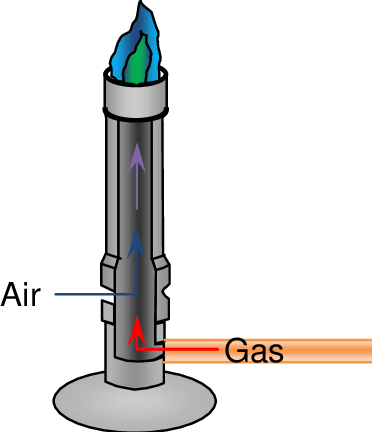
The burner typically consists of a metal casing and a sturdy base. The bottom usually features a hose connector for attaching rubber tubing that delivers gas from the laboratory's gas nozzle to the burner. The nozzle diameter depends on the type of gas used. A vertical tube above the gas inlet features small holes allowing air to enter the gas mixture from the sides. Once ignited, the gas burns at the top. An adjustable valve mounted at the base controls the amount of oxygen added to the mixture. Less air produces a weaker flame; more air yields a stronger flame.
Therefore, the amount of air supplied through the control valve (knob) is directly proportional to the flame's intensity and color. When the valve is closed, only a minimal amount of air (oxygen) passes through, producing a smoky yellow (low-temperature) flame. When the valve is opened, ample air enters, generating a fiery, nearly colorless flame. For example,
When the air holes are fully closed, it produces a yellow flame (safe flame).
When the air inlet is slightly opened, a red flame appears (low combustion power).
When the air inlet is partially opened (combustion power at half), a purple flame is produced.
When the air inlet is fully opened, a blue flame appears (intense combustion, dangerous).
Adjust the type of flame produced by modifying the air inlet of the Bunsen burner.
Functions and components of a bunsen burner
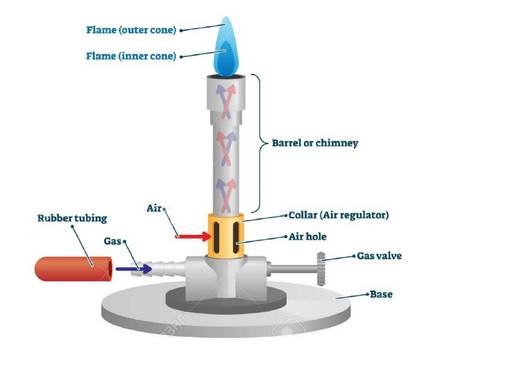
Image source: DOI:10.13140/RG.2.2.18145.66401
The bunsen burner is an essential part of laboratory equipment used for heating materials in the laboratory. It consists of seven major components: the base, gas valve, air holes, air regulator (collar), barrel (chimney), gas nozzle, and gas intake tube.
Base: It helps support the Bunsen burner and allows direct contact with the work surface.
Gas valve: Used to control the flow of gas.
Air holes: They allow air to enter the burner, enabling air or other liquids to mix with the gas.
Air regulator (collar): Its primary function is to control the amount of air entering the barrel.
Barrel (chimney): Gas mixes with air from the vent and ignites within it.
Gas nozzle: A plastic or rubber tube connected to the gas source. It facilitates the entry of gas into the burner.
Gas intake tube: A rubber tube that delivers gas to the Bunsen burner.
Fuel Sources for Bunsen Burners
The two primary fuel sources for Bunsen burners are natural gas (primarily methane) and liquefied petroleum gas (LPG, a mixture of propane, butane, or both). A burner designed for one fuel type must never be used with another fuel type. Therefore, the appropriate burner must be selected based on the available fuel source.
Types of Bunsen Burners
Meker Fisher Burner:
Features a larger chimney diameter. Due to its increased size, air and gas mix more thoroughly. A grid at the top of the chimney divides the flame into smaller beams. A gas valve located on or below the chimney regulates gas flow.
Tecru Burner:
This burner generates heat more efficiently. Its longer barrel compared to other burners allows for more thorough air-gas mixing, enhancing flame combustion power. Additionally, a nut on the barrel adjusts gas flow.
Tyril Burner:
At the barrel base, it incorporates a disc valve to regulate gas flow into the burner.
Types of Bunsen Burner Flames
Luminous Flame
This flame is easily visible in well-lit areas, hence its designation as a safety flame. It forms when the air vent is fully closed, reaching temperatures around 300 degrees.
Reducing Flame
When the air vent is only partially open, the flame is difficult to see in bright environments. This flame is known as a blue flame, reaching temperatures up to 500 degrees.
Oxidizing Flame
This is the hottest flame produced when the air vent is fully open, reaching temperatures up to 700 degrees.
Operating Procedures for Bunsen Burner
Wear a lab coat and safety goggles. (Long hair should be tied back.)
Connect the rubber tube to the gas valve, ensuring the connection is secure.
Close the air adjustment hole and prepare the igniter or matches.
Ignite the flame source first, then slowly open the gas valve to ignite. Light a match 3 cm above the top of the burner tube and hold it in that position.
Turn the gas valve to the “ON” position.
After use, close the gas valve first and allow the flame to extinguish naturally.
After the Bunsen burner has cooled, shut off the gas supply, inspect the equipment, and tidy the laboratory bench.
What is the use of bunsen burner
Flame sterilization of inoculation loops, needles, and test tube mouths in microbiology laboratories.
Heating in chemistry laboratories
Dehydration of complexes, drying of salts, moisture analysis, and identification of crystalline water.
Assisting in determining melting points via calorimetry and boiling points via the Tilley tube method.
Determining the flammability of compounds and the flash point of solvents.
Advantages of Bunsen Burners
Easy to operate
Low heating costs
Can be used wherever natural gas is available
Burners come in multiple sizes
Adjustable air intake allows for flames of varying temperatures
Limitations of Bunsen Burners
Temperature cannot be precisely maintained
Highly flammable
Extremely high combustion temperatures may cause accidents if mishandled
Conclusion
In summary, the bunsen burner remains one of the most essential heating tools in laboratories. By understanding its main parts, different flame types, and common applications, users can operate it more safely and efficiently. Despite the development of modern heating equipment, the bunsen burner continues to play an important role in chemistry education, research experiments, and routine laboratory work due to its simplicity, reliability, and precise flame control.
As a professional lab and medical equipment manufacturer, Scitek Global is certified by ISO 9001, ISO 13485, ISO 45001 and ISO 14001. Almost all our products are certified by ETL, CE and FDA .
Scitek Global looks forward to establishing cooperation with more distributors all over the world, and working together to create greater customer value.

 English